English and
 Español. After purchase, use the language toggle in your course Player to switch between English and Spanish at any time.

 EN
EN ES
ES
































































































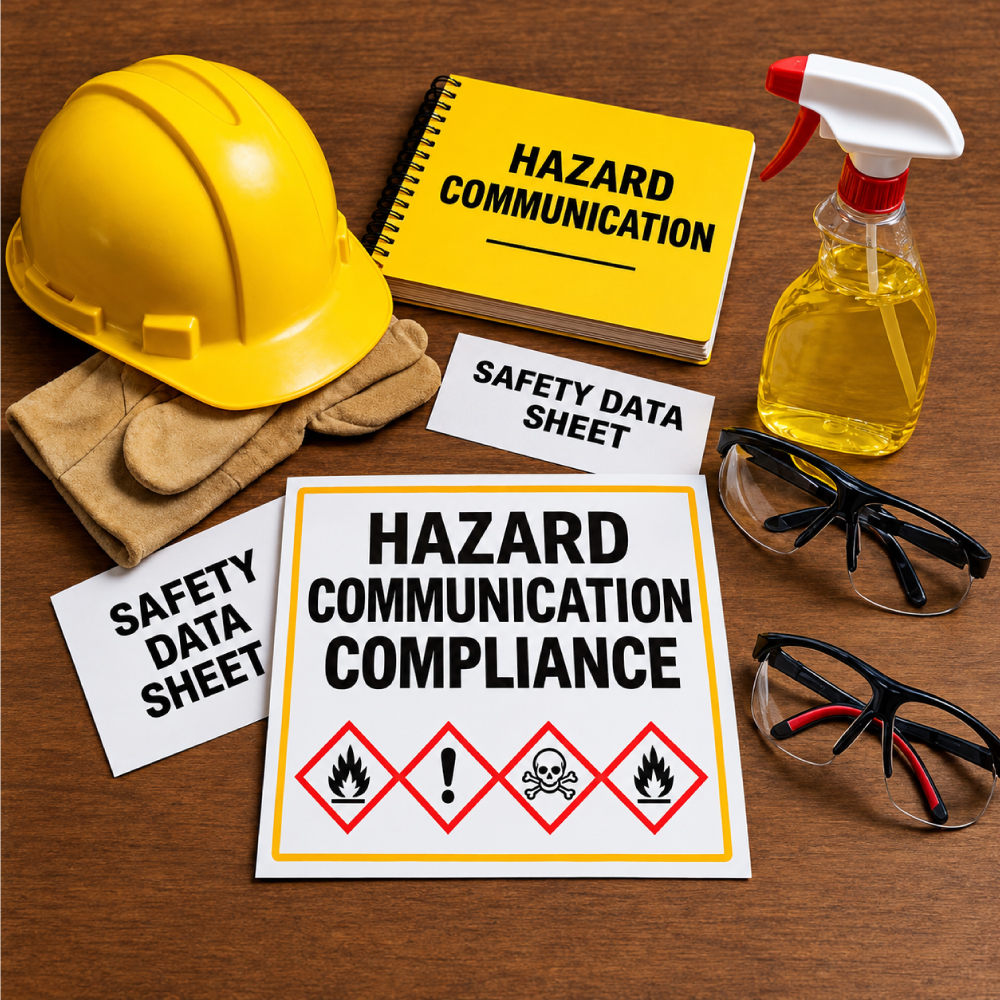











Glossary - Cal/OSHA Hazard Communication (HazCom) with GHS Training
Article
- Article means a manufactured item: which is formed to a specific shape or design during manufacture;
- which has end use function(s) dependent in whole or in part upon its shape or design during end use; and
- which does not release, or otherwise result in exposure to, a hazardous chemical under normal conditions of use or in a reasonably foreseeable emergency resulting from workplace operations.
Assistant Secretary
Assistant Secretary means the Assistant Secretary of Labor for Occupational Safety and Health, U.S. Department of Labor, or a designee.
B
No terms found
CAS
An acronym that stands for Chemical Abstracts Service.”.
Chemical
Chemical means any substance, or mixture of substances.
Chemical Manufacturer
Chemical manufacturer means an employer with a workplace where chemical(s) are produced for use or distribution.
Chemical Name
Chemical name means the scientific designation of a chemical in accordance with the nomenclature system developed by the International Union of Pure and Applied Chemistry (IUPAC) or the Chemical Abstracts Service (CAS) rules of nomenclature, or a name that will clearly identify the chemical for the purpose of conducting a hazard classification.
Classification
Classification means to identify the relevant data regarding the hazards of a chemical, review those data to ascertain the hazards associated with the chemical, and decide whether the chemical will be classified as hazardous according to the definition of a hazardous chemical in Title 8 CCR Section 5194. In addition, classification for health and physical hazards includes the determination of the degree of hazard, where appropriate, by comparing the data with the criteria for health and physical hazards.
Commercial Account
Commercial account means an arrangement whereby a retail distributor sells hazardous chemicals to an employer, generally in large quantities over time and/or at costs that are below the regular retail price.
Common Name
Common name means any designation or identification such as code name, code number, trade name, brand name, or generic name used to identify a chemical other than by its chemical name.
Container
Container means any bag, barrel, bottle, box, can, cylinder, drum, reaction vessel, storage tank, tank truck, or the like that contains a hazardous chemical. For purposes of Title 8 CCR Section 5194, pipes or piping systems are not considered to be containers.
Designated Representative
Designated representative means any individual or organization to whom an employee gives written authorization to exercise such employee’s rights under Title 8 CCR Section 5194. A recognized or certified collective bargaining agent shall be treated automatically as a designated representative without regard to written employee authorization.
Director
Director means the Director of Industrial Relations, California Department of Industrial Relations, or designee.
Distributor
Distributor means a business, other than a chemical manufacturer or importer, which supplies hazardous chemicals to other distributors or employers.
Employee
Under Cal/OSHA Section 5194, an employee is anyone an employer requires or directs to work or to be present at a place of employment.
Employer
Under Cal/OSHA Section 5194, employers include state and local government bodies, public and quasi-public corporations and agencies, persons or public service corporations with someone in their service, and legal representatives of deceased employers.
Exposure or Exposed
Any situation arising from work operation where an employee may ingest, inhale, absorb through the skin or eyes, or otherwise come into contact with a hazardous chemical.
Foreseeable Emergency
Foreseeable emergency means any potential occurrence such as, but not limited to, equipment failure, rupture of containers, or failure of control equipment which could result in an uncontrolled release of a hazardous chemical into the workplace.
GHS
An abbreviation that stands for “Globally Harmonized System of Classification and Labeling of Chemicals.”
Hazard Category
Hazard category means the division of criteria within each hazard class, e.g., oral acute toxicity and flammable liquids include four hazard categories. These categories compare hazard severity within a hazard class and should not be taken as a comparison of hazard categories more generally.
Hazard Class
Hazard class means the nature of the physical or health hazards, e.g., flammable solid, carcinogen, oral acute toxicity.
Hazard Not Otherwise Classified
Hazard not otherwise classified means an adverse physical or health effect identified through the evaluation of scientific evidence during the classification process that does not meet the specified criteria for the physical and health hazard classes addressed in Title 8 CCR Section 5194. This does not extend coverage to adverse physical and health effects for which there is a hazard class addressed in Title 8 CCR Section 5194, but the effect either falls below the cut-off value/concentration limit of the hazard class or is under a GHS hazard category that has not been adopted by OSHA (e.g., acute toxicity Category 5).
Hazard Statement
Hazard statement means a statement assigned to a hazard class and category that describes the nature of the hazard(s) of a chemical, including, where appropriate, the degree of the hazard.
Hazardous Chemical
Hazardous chemical means any chemical which is classified as a physical hazard or a health hazard, a simple asphyxiant, combustible dust, pyrophoric gas, a hazard not otherwise classified, or is included in the List of Hazardous Substances prepared by the Director pursuant to Labor Code section 6382.
Health Hazard
Health hazard means a chemical which is classified as posing one of the following hazardous effects: acute toxicity (any route of exposure); skin corrosion or skin irritation; serious eye damage or eye irritation; respiratory or skin sensitization; germ cell mutagenicity; carcinogenicity; reproductive toxicity; specific target organ toxicity (single or repeated exposure); or aspiration hazard. The criteria for determining whether a chemical is classified as a health hazard are detailed in subsection (d) and Appendix A to Section 5194— Health Hazard Criteria.
HNOC
An abbreviation that stands for “Hazard Not Otherwise Classified.”
Immediate Use
Immediate use means that the hazardous chemical will be under the control of and used only by the person who transfers it from a labeled container and only within the work shift in which it is transferred.
Importer
Importer means the first business with employees within the Customs Territory of the United States which receives hazardous chemicals produced in other countries for the purpose of supplying them to distributors or employers within the United States.
J
No terms found
K
No terms found
Label
A label means an appropriate group of written, printed, or graphic information elements concerning a hazardous chemical that is affixed to, printed on, or attached to the immediate container of a hazardous chemical, or to the outside packaging.
Label Elements
Label elements mean the specified pictogram, hazard statement, signal word, and precautionary statement for each hazard class and category.
Mixture
Mixture means a combination or a solution composed of two or more substances in which they do not react.
N
No terms found
OSHA
An acronym that stands for “Occupational Safety and Health Administration.”
Physical Hazard
Physical hazard means a chemical that is classified as posing one of the following hazardous effects: explosive; flammable (gases, aerosols, liquids, or solids); oxidizer (liquid, solid or gas); self-reactive; pyrophoric (liquid or solid); self-heating; organic peroxide; corrosive to metal; gas under pressure; combustible liquid; water-reactive; or in contact with water emits flammable gas. See Appendix B to Section 5194—Physical Hazard Criteria.
Pictogram
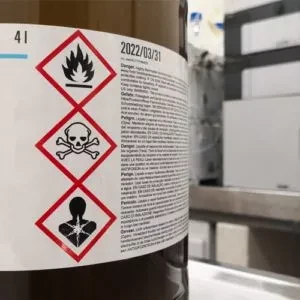
A pictogram means a composition that may include a symbol plus other graphic elements, such as a border, background pattern, or color, that is intended to convey specific information about the hazards of a chemical. Eight pictograms are designated under this standard for application to a hazard category.
Precautionary Statement
A precautionary statement means a phrase that describes recommended measures that should be taken to minimize or prevent adverse effects resulting from exposure to a hazardous chemical, or improper storage or handling.
Produce
Produce means to manufacture, process, formulate, blend, extract, generate, emit, or repackage.
Product Identifier
Product identifier means the name or number used for a hazardous chemical on a label or in the SDS. It provides a unique means by which the user can identify the chemical. The product identifier used shall permit cross-references to be made among the list of hazardous chemicals required in the written hazard communication program, the label, and the SDS.
Pyrophoric Gas
Pyrophoric gas means a chemical in a gaseous state that will ignite spontaneously in air at a temperature of 130 degrees F (54.4 degrees C) or below.
Q
No terms found
Responsible Party
Responsible party means someone who can provide additional information on the hazardous chemical and appropriate emergency procedures, if necessary.
Safety Data Sheet
Safety data sheet means written or printed material concerning a hazardous chemical that is prepared in accordance with subsection (g) of Title 8 CCR Section 5194 .
SDS
An abbreviation that stands for “Safety Data Sheet.”
Signal Word
Signal word means a word used to indicate the relative level of severity of a hazard and alert the reader to a potential hazard on the label. The signal words used in Title 8 CCR Section 5194 are “danger” and “warning.” “Danger” is used for the more severe hazards, while "warning" is used for the less severe.
Simple Asphyxiant
Simple asphyxiant means a substance or mixture that displaces oxygen in the ambient atmosphere and can, thus, cause oxygen deprivation in those who are exposed, leading to unconsciousness and death.
Specific Chemical Identity
Specific chemical identity means the chemical name, Chemical Abstracts Service Registry Number, or any other information that reveals the precise chemical designation of the substance.
Substance
Substance means chemical elements and their compounds in the natural state or obtained by any production process, including any additive necessary to preserve the stability of the product and any impurities deriving from the process used, but excluding any solvent which may be separated without affecting the stability of the substance or changing its composition.
Trade Secret
Trade secret means any confidential formula, pattern, process, device, information, or compilation of information that is used in an employer's business, and that gives the employer an opportunity to obtain an advantage over competitors who do not know or use it. A trade secret shall not include chemical identity information which is readily discoverable through qualitative analysis. Appendix E to Section 5194—Definition of Trade Secret sets out the criteria to be used in evaluating trade secrets.
Use
Use means to package, handle, react, emit, extract, generate as a byproduct, or transfer.
V
No terms found
Work Area
Work area means a room or defined space in a workplace where hazardous chemicals are produced or used, and where employees are present.
Workplace
Workplace means an establishment, job site, or project, at one geographical location containing one or more work areas.
X
No terms found
Y
No terms found
Z
No terms found