English and
 Español. After purchase, use the language toggle in your course Player to switch between English and Spanish at any time.

 EN
EN ES
ES



























































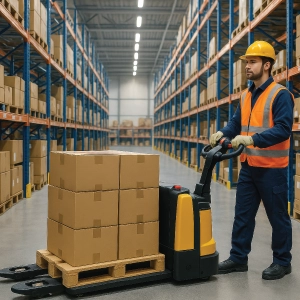





































































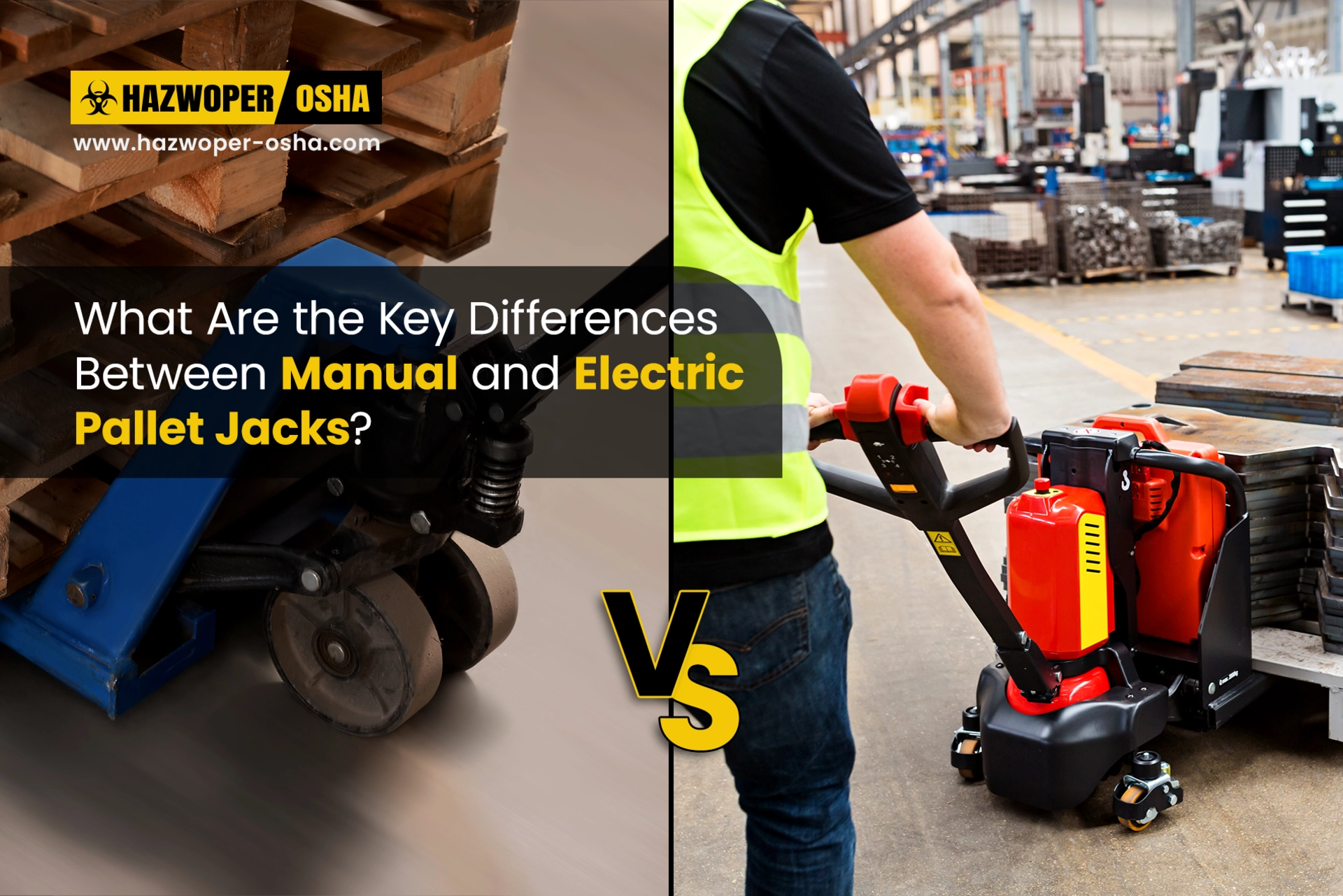
What are the Key Differences Between Manual vs Electric Pallet Jack?
Introduction:
Every day, warehouses quietly move thousands of pallets, powering everything from retail shelves to industrial supply chains. And most of that movement depends on one of the simplest tools in the operation: the pallet jack.
It’s interesting to note that the biggest inefficiencies in warehouse operations don’t usually come from breakdowns or major failures. They come from small, repeated decisions, like choosing which pallet jack is appropriate for the task at hand. Because on paper, the choice between manual and electric pallet jacks looks obvious:
But in real warehouse conditions, that assumption quickly breaks down.
When your team moves 20 pallets a day versus 200, the nature of the operation changes significantly, especially as travel distances increase across large floor layouts, congestion builds in narrow aisles or dock zones, and fatigue reduces consistency toward the end of a shift. At that point, the challenge is no longer just about selecting the right equipment; it becomes a question of operational stressors and how effectively the entire workflow is designed to handle volume, movement, and human limitations under real working conditions.
And here’s the key insight most operations miss;
A pallet jack doesn’t determine performance in isolation. It amplifies whatever system it operates in; efficient layouts become faster, inefficient ones become more expensive. That means in some environments, a manual pallet jack is the most practical, cost-efficient choice. In others, it quietly becomes a bottleneck that limits throughput.
In this blog, we’ll break down the key differences between manual and electric pallet jacks through the lens that matters most to employers: productivity, labor efficiency, total cost over time, and operational risk.
The Operational Difference Between Manual and Electric Pallet Jacks: Propulsion and Inertia
The key difference between manual and electric pallet jacks lies in how force is generated and how movement occurs, defined by two mechanics: propulsion and inertia.
A manual pallet jack relies entirely on human torque. The operator pumps the handle to lift and physically pushes or pulls to move the load, meaning every stage of motion, starting, sustaining, and stopping, depends on continuous physical effort.
An electric pallet jack replaces this with motor-driven torque. An electric motor powers movement, so the operator mainly controls direction and positioning while the system provides consistent propulsion.
The second difference is inertia control. With manual units, the operator must overcome resistance to initiate movement and actively manage stopping and turning by applying physical force. With electric pallet jacks, acceleration and deceleration are mechanically assisted, making transitions smoother and less dependent on human input.
In essence, manual pallet jacks convert human effort directly into motion. In contrast, electric pallet jacks use mechanical power to handle propulsion and inertia, shifting the operator’s role to control rather than force generation.
How Do Manual vs Electric Pallet Jacks Impact Warehouse Productivity?
Once the differences in propulsion and inertia are understood, the next consideration is how each system affects cycle consistency and overall warehouse throughput. The real productivity difference is not how the load feels in motion, but how long operators can sustain movement without output slowing over time.
With manual pallet jacks, every cycle depends entirely on operator exertion. Each start requires physical force to overcome resistance, and every stop, turn, or repositioning interrupts momentum. As these actions repeat throughout a shift, fatigue gradually increases, leading to more segmented, inconsistent movements. Operators naturally slow down, pause more frequently, and require longer recovery periods between transport cycles.
This segmented movement pattern creates unpredictable cycle times. Early in a shift, operators may sustain a steady pace, but as physical exhaustion accumulates, the output rate begins to decay. The number of completed load movements per hour can fluctuate significantly depending on operator endurance, travel distance, and load weight.
Electric pallet jacks reduce this disruption by maintaining momentum through motor-assisted propulsion and controlled acceleration. Because the equipment carries much of the physical workload, operators can sustain a more uniform pace across repeated travel cycles without the same decline in performance.
The advantage is not simply smoother movement. Electric pallet jacks help standardize warehouse speed itself. Travel times become more predictable, interruptions between cycles decrease, and operators can complete more consistent load movements throughout an entire shift. Instead of productivity gradually tapering as fatigue increases, electric systems deliver a steadier, more repeatable output rate across warehouse operations.
How Do Labor Costs and Workforce Efficiency Differ Between the Two?
In warehouse operations, labor costs are not determined solely by equipment price; they are shaped by how much output each worker consistently generates per shift. The difference between manual and electric pallet jacks becomes most visible in how they affect work intensity, fatigue accumulation, and task throughput over time.
How Does Equipment Choice Affect Staffing Needs?
Equipment choice influences staffing indirectly through labor productivity per worker rather than eliminating tasks entirely. Motorized pallet jacks reduce repetitive physical strain, helping minimize fatigue, burnout, and musculoskeletal stress, and can also support better worker retention in high-frequency material-handling environments.
Manual systems typically require more labor hours to move the same volume of pallets because output declines with fatigue and repetition. Electric systems improve per-worker consistency, allowing teams to handle higher throughput within the same shift structure.
However, staffing requirements still depend heavily on:
- warehouse layout efficiency
- travel distance between zones
- workflow design (picking, staging, replenishment)
In practice, equipment improves labor efficiency, but does not automatically reduce total headcount unless workflow constraints are also optimized.
Training and Compliance Requirements for Electric and Manual Jack Pallets
Electric pallet jacks introduce higher training and compliance requirements. Operators typically require formal equipment training due to powered movement, braking systems, and load-handling risks, whereas manual pallet jacks generally involve simpler operation with less stringent compliance expectations.
The Cost of Energy Decay
Labor cost is not just about wages, but about how much value a worker can consistently generate throughout a shift. In manual material handling, physical fatigue gradually reduces output, with worker performance often dropping by 20–30% during the final hours of repetitive work. Even though the hourly wage remains fixed, the operational value produced per hour declines as exhaustion builds.
Electric pallet jacks reduce this “energy decay” by shifting propulsion effort from the worker to the motor. Unlike human stamina, the motor maintains consistent performance from 8:00 AM to 5:00 PM, helping stabilize the value generated per labor hour throughout the shift.
Because operators experience less physical exhaustion, they are also more likely to stay alert, focused, and mentally engaged when reassigned to higher-value tasks that require attention, coordination, and decision-making rather than continuous physical exertion.
Which Work Environments Are Best Suited for Each Type?
The right pallet jack is determined not just by workload, but by the operational conditions inside the facility. Factors such as ramp usage, floor condition, trailer loading, moisture exposure, and cold storage environments can directly limit which type performs safely and efficiently.
Manual and electric pallet jacks both perform best on smooth, level indoor surfaces. However, as environmental complexity increases, the operational limitations of each system become more important.
When Are Manual Pallet Jacks the Better Fit?
Manual pallet jacks are most effective in:
- short-distance staging and dockside handling
- tight or congested spaces
- facilities with low-frequency pallet movement
They are also easier to operate in areas with limited charging infrastructure or inconsistent workflows.
However, manual units become less efficient in environments with:
- ramps or inclines
- rough or uneven floors
- frequent trailer loading
- wet or slippery surfaces
Because movement relies entirely on operator force, poor floor conditions and slopes significantly increase strain and reduce control.
When Do Electric Pallet Jacks Become the Preferred Choice?
Electric pallet jacks become more effective in:
- repetitive, high-frequency transport
- long-distance warehouse movement
- multi-shift inbound and outbound operations
- trailer loading and dock ramp usage
Powered movement provides better control on moderate inclines and reduces fatigue during continuous transport cycles. They are also commonly used in larger facilities where throughput consistency matters across shifts.
However, electric units also have operational constraints. Cold storage environments can affect battery performance, while moisture, outdoor exposure, and uneven terrain may reduce traction and increase wear on electrical and wheel components.
How Can Employers Choose the Right Mix for Maximum Efficiency?
In real warehouse systems, the choice between manual and electric pallet jacks is not based on preference or price alone; it is determined by workload intensity, travel structure, and how the equipment interacts with the overall flow of operations.
The pallet jack itself does not determine productivity; rather, it is how well it matches the warehouse's movement pattern.
1. Use workload intensity as the first decision filter
A practical threshold used in many warehouse planning models is daily pallet movement volume.
- Low-volume operations (intermittent movement) → Manual pallet jacks remain efficient because setup time is minimal and fatigue accumulation is limited.
- High-volume operations (repetitive movement across shifts) → Electric pallet jacks become more efficient as they reduce operator fatigue and stabilize cycle time consistency.
In real operations, the transition point is not binary; it is driven by how quickly operator fatigue begins affecting cycle repetition quality.
2. Match equipment type to travel distance and layout design
Distance is one of the strongest productivity multipliers in pallet movement.
- Short, localized movement (staging, dockside handling, small storage zones) → Manual is sufficient and often faster due to zero setup time.
- Medium to long-distance movement (cross-warehouse transport, outbound staging lanes) → Electric systems outperform due to sustained travel speed and reduced physical effort.
Warehouse layout research consistently shows that increased travel distance is a primary driver of labor inefficiency when manual systems are overused.
Key insight: inefficient layout + manual equipment compounds delays; efficient layout + electric equipment stabilizes flow.
3. Evaluate cycle repetition, not just speed
Many employers incorrectly assess productivity based on how fast a single pallet moves. In real operations, what matters is cycle repeatability over time.
- Manual pallet jacks: performance declines gradually due to fatigue, especially in repetitive routes
- Electric pallet jacks: maintain consistent cycle time across repeated movement tasks
This becomes critical in:
- outbound shipping lanes
- replenishment cycles
- cross-dock environments
Consistency, not peak speed, determines shift-level throughput.
4. Factor in congestion and shared traffic environments
Warehouse congestion has a direct impact on equipment efficiency.
- Manual units are more adaptable in tight, high-traffic zones due to a smaller operational footprint and immediate responsiveness.
- Electric units perform better in structured lanes where movement paths are predictable and less obstructed.
In congested environments, electric speed advantages often diminish because stopping, yielding, and repositioning become the dominant time cost, not travel speed.
5. Account for labor structure and fatigue absorption
Equipment choice directly influences how labor capacity is distributed across a shift.
- Manual systems shift all propulsion effort to workers, increasing fatigue accumulation over time
- Electric systems reduce physical load, allowing operators to sustain consistent output over longer durations
This is not just an ergonomic benefit it directly affects:
- error rates
- cycle consistency
- end-of-shift productivity drop-off
6. Apply a hybrid deployment model (real-world standard practice)
Most high-performing warehouses do not choose one system exclusively. Instead, they segment usage:
- Manual pallet jacks → short movements, staging, backup operations
- Electric pallet jacks → long-distance transport, high-frequency workflows
This hybrid model reduces unnecessary capital costs while optimizing efficiency at the task level rather than the equipment level.
- If movement is short, occasional, and space-constrained → Manual is optimal
- If movement is repetitive, distance-based, and shift-intensive → Electric is optimal
- If both exist in the same facility → Hybrid deployment delivers the highest efficiency
The most efficient warehouses are not those that choose the “best” pallet jack; they are those that match the right equipment to the right movement pattern within the facility's flow system.
Conclusion:
Manual and electric pallet jacks may look like simple tools. Still, in real warehouse operations, they directly influence how work flows, how efficiently labor is used, and how consistently materials move across a facility. The difference is not just in power or design, it is in how each system responds to distance, repetition, congestion, and overall workflow structure.
When equipment is matched correctly to the job, warehouses operate with fewer delays, more stable output, and better use of labor capacity. When it isn’t, even small inefficiencies begin to compound across shifts, affecting productivity in ways that are often overlooked until they become operational bottlenecks.
For employers and supervisors, the key takeaway is not to treat pallet jacks as interchangeable tools, but to treat them as part of a broader material handling system that requires a consistent understanding and proper application.
Building that understanding is where structured training becomes valuable. Programs such as the Pallet Jack (Manual & Electric) Online Training help reinforce safe handling practices, proper equipment use, and real-world operational awareness so teams are not only using the right tools but using them correctly in everyday warehouse conditions.
Frequently Asked Questions
Manual pallet jacks can last many years due to their simple hydraulic design. Electric pallet jacks typically have a shorter operational lifespan per component due to battery systems and motor wear, but can remain effective longer with proper maintenance cycles.
Safety depends more on operator behavior and traffic control than equipment type. However, electric pallet jacks may reduce strain-related injuries, while manual units offer more direct control in tight or congested spaces.
Yes, but performance varies. Manual pallet jacks require significantly more effort on slopes, while electric pallet jacks handle inclines more efficiently. However, both require careful load control to prevent instability.
Electric units require battery charging management, periodic inspection of electrical systems, wheel maintenance, and drive system servicing. Downtime planning is important to avoid workflow disruption.
Yes. Rough, uneven, or damaged flooring increases resistance and operator effort in manual units and can reduce efficiency or battery performance in electric models.
Yes, but performance may vary. Cold temperatures can reduce battery efficiency in electric pallet jacks, while manual pallet jacks may become harder to operate due to increased floor resistance.
Manual vs electric pallet jacks explained. Discover key differences in productivity, labor efficiency, and choosing the right fit for warehouses.