English and
 Español. After purchase, use the language toggle in your course Player to switch between English and Spanish at any time.

 EN
EN ES
ES





































































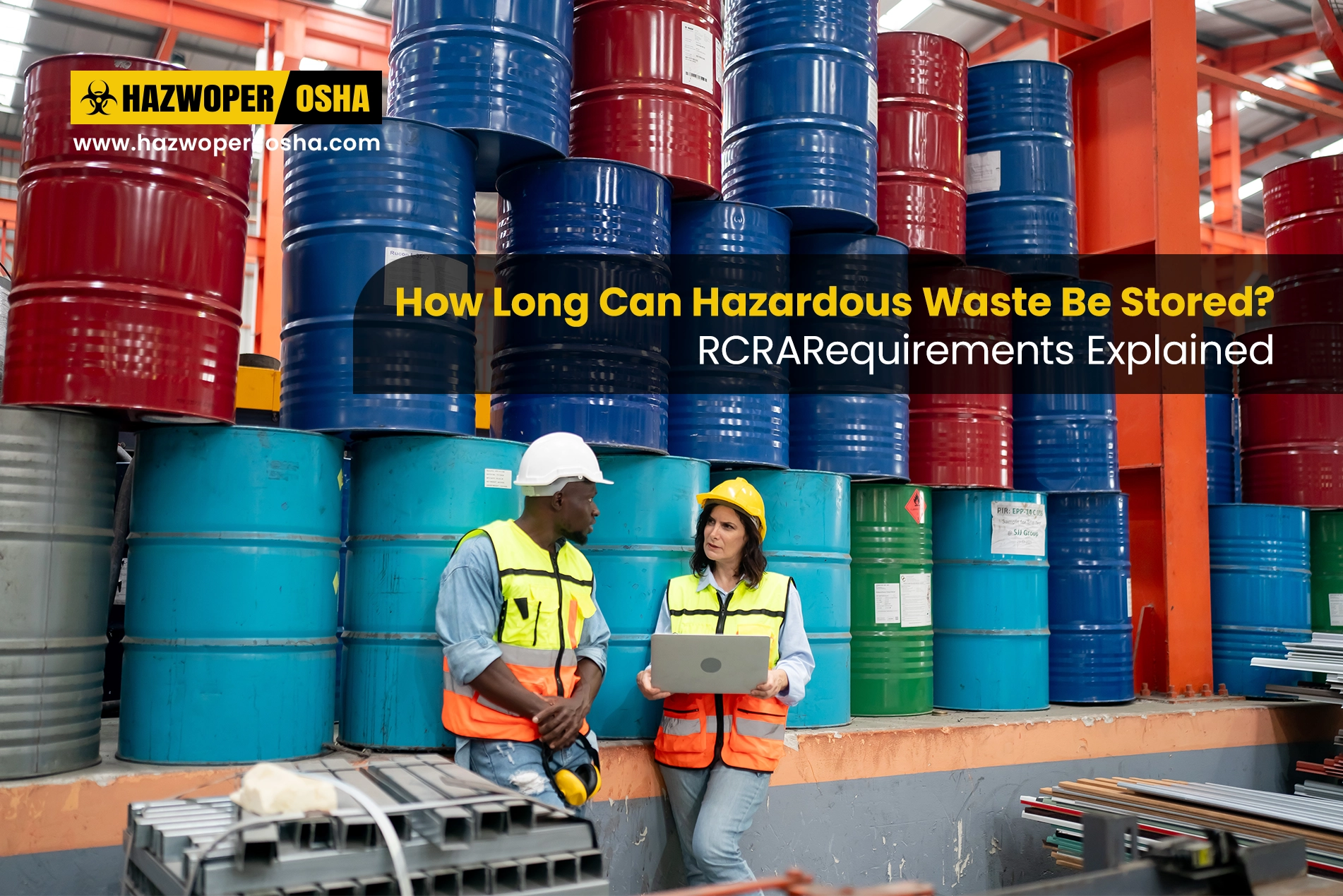
How Long Can Hazardous Waste Be Stored? RCRA Requirements Explained
Introduction:
How Long Can Hazardous Waste Be Stored? The answer isn't simply 90 days. Under federal RCRA requirements, hazardous waste compliance is quite complicated, and the number of days is only part of the answer.
Your generator category, where the waste is accumulated, when the applicable accumulation period begins, container and labeling requirements, and certain exceptions can all affect how the rules apply. Because states can impose requirements more stringent than federal RCRA standards, the federal deadline may not be the only requirement your facility needs to consider.
So, how long can you store or accumulate hazardous waste under RCRA? When does the accumulation clock actually start? What happens if waste remains on-site beyond the applicable time limit?
This blog breaks down RCRA hazardous waste accumulation time limits by generator category, explains the rules for satellite and central accumulation areas, covers what happens when you exceed the applicable deadline, and highlights the exceptions and state-specific requirements you need to know to manage hazardous waste compliantly.
How Generator Status Determines Your Time Limit
RCRA does not apply the same hazardous waste accumulation requirements to every facility. A generator's category is determined primarily by the amount and type of hazardous waste it generates in a calendar month, and that category determines the applicable accumulation requirements.
- VSQG: Generates ≤100 kg non-acute hazardous waste/month or ≤1 kg acute hazardous waste/month. No federal accumulation-time limit, but generally cannot exceed 1,000 kg on-site.
- SQG: Generates >100 to <1,000 kg non-acute hazardous waste/month. Generally may accumulate up to 180 days, or 270 days when transporting waste 200+ miles, with a 6,000 kg on-site limit.
- LQG: Generates ≥1,000 kg non-acute hazardous waste/month or >1 kg acute hazardous waste/month. Generally may accumulate waste for up to 90 days and has no federal 6,000 kg accumulation limit under the generator provisions.
Generator status depends on the amount and type of hazardous waste generated in a calendar month. This means a facility's applicable generator category can change when its waste generation changes.
For example, a facility that normally generates waste within the SQG range could generate 1,000 kg or more of non-acute hazardous waste during a particular month and become subject to LQG requirements for that month. Facilities should therefore track their hazardous waste generation monthly rather than if their generator category will always remain the same.
Waste generated and accumulated in satellite accumulation areas (SAAs) also counts toward the amount used to determine generator status for the month in which the waste is generated, subject to the applicable exclusions in the regulations.
What Is the RCRA Hazardous Waste Storage Time Limit?
Under the Resource Conservation and Recovery Act (RCRA), no single federal time limit applies to every hazardous waste generator. Instead, the time a generator may accumulate hazardous waste on-site without a storage permit depends mainly on its generator category and applicable RCRA requirements.
RCRA Hazardous Waste Accumulation Time Limits
Generator Category |
Federal Accumulation Time Limit |
|
Very Small Quantity Generator (VSQG |
No general federal accumulation-time limit |
|
Small Quantity Generator (SQG) |
Up to 180 days |
|
SQG transporting waste 200 miles or more |
Up to 270 days |
|
Large Quantity Generator (LQG) |
Up to 90 days |
An SQG facility may accumulate up to 6,000 kg of hazardous waste on-site. The 270-day period applies when hazardous waste must be transported at least 200 miles to the designated facility. For a practical refresher on RCRA generator requirements, explore the RCRA Hazardous Waste Generator Refresher Training.
VSQGs follow a different federal regulatory framework and do not have the same 90-, 180-, or 270-day accumulation limits. However, they must continue to meet the conditions of the VSQG exemption, including applicable quantity limits.
Is Hazardous Waste Accumulation the Same as Storage?
Not exactly. Under RCRA, storage generally requires a hazardous waste storage permit. At the same time, qualifying generators may accumulate hazardous waste on-site without a storage permit when they meet the applicable generator requirements and accumulation standards.
Therefore, the commonly cited 90-, 180-, and 270-day rules are accumulation time limits, not a universal rule stating that hazardous waste can only remain on-site for those periods.
When Does the RCRA Hazardous Waste Storage Clock Start?
The RCRA accumulation clock does not always start when hazardous waste is first generated. It depends on whether the waste is placed directly in a central accumulation area (CAA) or first managed under the satellite accumulation area (SAA) provisions. A Satellite Accumulation Area (SAA) is a designated area near the point of generation where a generator may accumulate hazardous waste under specific requirements. A Central Accumulation Area (CAA) is the facility’s designated area for accumulating hazardous waste before shipping it off-site.
For waste managed in an SAA, the applicable accumulation clock generally begins when the waste is moved to the CAA or otherwise becomes subject to the generator’s central accumulation requirements. Waste placed directly in a CAA is subject to the applicable accumulation time limit from the date it is first placed there.
When the Clock Starts in a Central Accumulation Area
For waste placed directly into a central accumulation unit, the accumulation period generally begins when waste is first placed in the unit. For example, an LQG placing hazardous waste into a central accumulation container on September 1 would use September 1 as the accumulation start date.
How Satellite Accumulation Areas Affect the Clock?
LQGs and SQGs may accumulate up to 55 gallons of non-acute hazardous waste at an SAA, subject to applicable requirements. The central accumulation clock does not begin while the waste remains within the SAA limits.
If the 55-gallon limit is exceeded, the excess waste must be dated and moved within three consecutive calendar days to a central accumulation area or another permitted destination. When moved to the CAA, date the container again to begin the applicable 90- or 180-day accumulation period.
Key takeaway: Always identify where the waste is being accumulated first. The location and applicable SAA provisions determine when the central accumulation period begins.
What Must Be Done During the RCRA Accumulation Period?
Meeting the accumulation time limit is only one part of RCRA compliance. During this period, generators must properly manage hazardous waste containers, maintain required markings and dates, conduct applicable inspections, and keep required records. Requirements vary by generator category.
Hazardous Waste Container Requirements
Containers must be in good condition, compatible with the waste, and kept closed except when adding or removing waste. Keep incompatible wastes from being mixed in a way that could cause a hazardous reaction. For central accumulation areas, containers must be marked with “Hazardous Waste,” an indication of the hazards of their contents, and the applicable accumulation start date. SQGs and LQGs must inspect container storage areas at least weekly for leaks and deterioration.
Records and Documentation to Maintain
Recordkeeping requirements depend on the generator category. SQGs and LQGs generally must maintain records such as:
- Waste determination and testing records
- Hazardous waste manifests
- Required exception reports
- Biennial reports for LQGs
- Other records required under applicable RCRA provisions
EPA specifically identifies waste testing records, manifests, biennial reports, and exception reports among the generator recordkeeping requirements.
Key takeaway: Proper accumulation requires more than removing waste before the deadline. Generators must maintain compliant containers and accumulation areas while keeping the documentation needed to demonstrate compliance.
What Happens If Hazardous Waste Exceeds the RCRA Time Limit?
If hazardous waste remains in accumulation beyond the applicable RCRA time limit, the generator may no longer qualify for the applicable accumulation provisions and could face regulatory violations, enforcement actions, and penalties.
LQGs and SQGs that exceed their applicable accumulation period without an authorized extension can become subject to the requirements that apply to hazardous waste storage facilities. EPA allows for a 30-day extension in qualifying cases involving unforeseen, temporary, and uncontrollable circumstances, but the Regional Administrator or authorized state grants the extension on a case-by-case basis.
Finally, these are federal RCRA requirements. Authorized states may have generator categories or requirements that differ from or are more stringent than the federal standards, so facilities should verify the rules applicable in their state.
Conclusion:
Managing hazardous waste within applicable RCRA accumulation time limits is essential to maintain compliance and prevent avoidable violations. Generators should know when the accumulation clock starts, identify the requirements for their generator category, and ensure hazardous waste is properly managed throughout the accumulation period. Timely shipment to an authorized facility is also critical to avoid exceeding the applicable deadline.
Consistent labeling, container management, inspections, recordkeeping, and deadline tracking can help organizations maintain control of hazardous waste from the point of accumulation through final shipment. Regularly reviewing generator status and accumulation practices can also help facilities identify compliance gaps before they become violations.
Frequently Asked Questions