 English and
 Español. After purchase, use the language toggle in your course Player to switch between English and Spanish at any time.

 EN
EN ES
ES








































































































































What is HIPAA Compliance? A Complete Guide to Workplace Safety and Regulatory Requirements
Introduction
Workplace injuries and illnesses rose by 11% in 2023 compared to the previous years, with 375,111 reported cases alone by the healthcare sector, which is 28% of all incidents across all industries. This notable rise shows the need for a stringent regulatory framework like HIPAA that protects sensitive patient data and keeps workplaces safer, especially in healthcare and related fields. HIPAA compliance was established in 1996 under the Health Insurance and Accountability Act. It sets strict standards for protecting Protected Health Information (PHI) so that it stays confidential and secure. HIPAA applies to the covered entities, such as insurers and healthcare providers, as well as their business associates, such as IT vendors and billing companies that deal with PHI. Beyond legal compliance, HIPAA also helps in risk mitigation, developing patient trust and addressing major challenges of data breaches in complex healthcare environments. Therefore, in this detailed guide, we will explore how HIPAA compliance is a cornerstone for workplace safety and regulatory adherence.
Major HIPAA Rules and Compliance Requirements
HIPAA compliance in 2026 is no longer limited to documentation, policies, and periodic training. The regulatory focus has shifted strongly toward cybersecurity enforcement, continuous risk monitoring, and protection of digital infrastructure.
Healthcare organizations are now expected to implement proactive security controls rather than relying solely on annual compliance checks.
Key Updates in 2026:
Stronger emphasis on cybersecurity safeguards: Covered entities are expected to adopt advanced protections such as multi-factor authentication (MFA), endpoint detection systems, and continuous threat monitoring.
Shift from periodic audits to continuous compliance monitoring: Instead of annual risk assessments alone, organizations are expected to maintain ongoing risk visibility across systems handling Protected Health Information (PHI).
Cloud security accountability: HIPAA compliance now extends more strictly to cloud service providers, requiring stronger Business Associate Agreements (BAAs) and real-time security controls.
Encryption expectations have become standard practice: Both data-at-rest and data-in-transit encryption are now considered baseline requirements rather than optional safeguards.
Increased focus on vendor risk management: Organizations must actively monitor third-party vendors for compliance gaps, security vulnerabilities, and access control weaknesses.
2026 HIPAA Compliance Checklist
To stay compliant in 2026, organizations should implement the following structured safeguards:
1. Technical Safeguards
Multi-factor authentication (MFA) for all PHI access points
Role-based access control (RBAC)
End-to-end encryption for PHI storage and transmission
Automated audit logging and monitoring systems
Secure cloud configuration and access restrictions
2. Administrative Safeguards
Updated HIPAA risk assessment (conducted regularly, not annually only)
Workforce security training with role-based modules
Incident response and breach reporting plan
Vendor and Business Associate Agreement (BAA) management
Internal compliance audits and corrective action tracking
3. Physical Safeguards
Controlled facility access for systems storing PHI
Secure workstation usage policies
Device tracking and mobile device management (MDM) systems
Proper disposal of hardware containing sensitive data
HIPAA Compliance Workflow (Modern 2026 Approach)
HIPAA compliance in 2026 is treated as a continuous lifecycle of security, monitoring, and improvement, rather than a one-time checklist or annual audit activity. Organizations are expected to maintain ongoing visibility into systems handling Protected Health Information (PHI) and actively reduce risk in real time.
1. Risk Identification
Identify and document all systems, applications, devices, and third-party vendors that store, process, or transmit PHI.
This includes:
Internal databases and EHR systems
Cloud storage platforms
Employee devices (laptops, mobile phones)
External vendors and SaaS tools
The goal is to build a complete PHI data flow map across the organization.
2. Risk Assessment
Evaluate potential vulnerabilities across all identified systems, focusing on how PHI could be exposed, altered, or accessed without authorization.
Key areas include:
Data storage security gaps
Weak or outdated authentication controls
Unsecured data transmission channels
Third-party integration risks
Misconfigured cloud environments
Risk assessments are increasingly expected to be continuous or frequently updated, not just annual exercises.
3. Security Implementation
Implement technical and administrative safeguards to reduce identified risks and strengthen system security.
Common controls include:
Encryption for data at rest and in transit
Multi-factor authentication (MFA) across all access points
Role-based access control (RBAC) to limit PHI exposure
Secure system configuration and patch management
Endpoint protection and device security policies
These controls should be aligned with a zero-trust security approach, where access is continuously verified.
4. Workforce Training
Train employees based on their specific access levels and interaction with PHI systems.
Training should include:
Data privacy and HIPAA responsibilities
Phishing and social engineering awareness
Secure handling of electronic PHI (ePHI)
Reporting procedures for suspected incidents
Role-specific compliance responsibilities
In 2026, training is expected to be ongoing and scenario-based, not just annual awareness sessions.
5. Continuous Monitoring
Implement real-time monitoring systems to detect unauthorized access, anomalies, or potential breaches.
This includes:
Security Information and Event Management (SIEM) systems
Automated audit logs for PHI access
Intrusion detection and prevention systems
Alerts for unusual login or data transfer activity
Continuous monitoring ensures organizations can respond to threats before they escalate into breaches.
6. Incident Response
Maintain a structured and tested incident response plan to manage security breaches or suspected HIPAA violations.
A strong response plan includes:
Defined roles and responsibilities
Immediate containment procedures
Evidence preservation and investigation steps
Regulatory breach notification timelines
Post-incident reporting and corrective actions
Organizations are expected to respond quickly and document every step for compliance audits.
7. Vendor Compliance Review
Regularly assess Business Associates and third-party vendors to ensure they meet HIPAA security requirements.
This includes:
Reviewing Business Associate Agreements (BAAs)
Auditing vendor security controls
Verifying encryption and access management practices
Monitoring ongoing compliance status
Terminating or replacing non-compliant vendors
Vendor risk management has become a critical HIPAA enforcement focus area in 2026, especially due to increased cloud and SaaS dependencies.
Frequently Asked Questions on HIPAA Compliance (2026)
Healthcare organizations and their business associates must clearly understand HIPAA compliance requirements to avoid violations and protect Protected Health Information (PHI). Below are some of the most common questions explained in a simplified format.
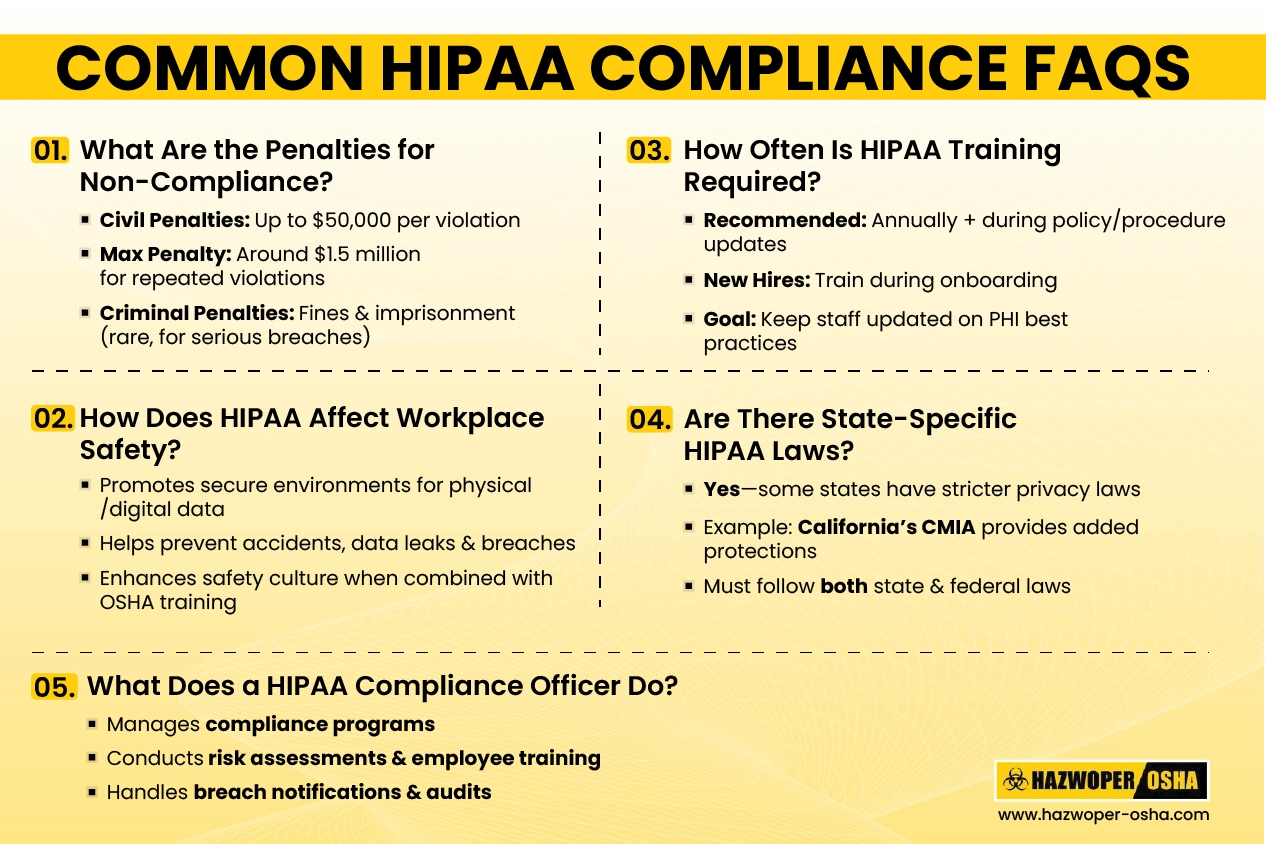
What are the penalties for non-compliance with HIPAA?
HIPAA violations can result in both civil and criminal penalties enforced by the Office for Civil Rights (OCR).
Civil penalties can range from tiered fines per violation, reaching up to millions of dollars for repeated or willful neglect cases.
In severe situations, criminal penalties may also apply, including financial fines and potential imprisonment, especially when violations involve intentional misuse of patient data.
How often should HIPAA training be conducted?
HIPAA does not specify a fixed training frequency, but organizations are expected to ensure ongoing employee awareness.
Best practice includes:
Training during onboarding for new employees
Annual refresher training for all staff
Immediate updates when policies, systems, or regulations change
Regular training helps reduce human error, which remains one of the leading causes of data breaches.
Do state-specific HIPAA laws exist?
Yes. While HIPAA is a federal law, many U.S. states have additional privacy regulations that may be stricter than federal requirements.
Organizations must comply with both HIPAA and applicable state laws. In cases where state laws are more protective, the stricter regulation takes priority.
For example, some states have enhanced rules around medical record confidentiality and patient consent requirements.
DWhat role does a HIPAA Compliance Officer play?
A HIPAA Compliance Officer is responsible for overseeing the organization’s compliance program and ensuring all HIPAA requirements are properly implemented.
Key responsibilities include:
Conducting risk assessments
Developing and maintaining HIPAA policies
Managing employee training programs
Monitoring compliance activities
Coordinating breach response and reporting
The compliance officer also plays a key role in audits and regulatory investigations, ensuring proper documentation and corrective actions.
Final Thoughts
More than a regulatory requirement, HIPAA compliance is a critical safeguard against data breaches, operational risks, and legal consequences. Covered entities and business associates must protect patient data by imposing security measures, performing regular risk assessments, and ensuring that the employees are sticking to HIPAA regulations. With rising cyber threats globally, organizations need stricter enforcement, and non-compliant people risk severe financial penalties and reputational damages. One of the easiest ways to comply with HIPAA is with the help of comprehensive employee training such as HIPAA General Awareness Training. It will ensure that your team members understand HIPAA rules, its security protocols, and fines for non-compliance. Businesses that want to reinforce their compliance efforts can also get structured HIPAA training programs to help them understand the complex regulations and develop a safer workplace culture.
References:
The HIPAA Journal, OSHA Publishes Workplace Injury and Illness Data for Calendar Year 2023, 13th Dec 2024, https://www.hipaajournal.com/osha-workplace-injury-illness-data-2023/
Centers for Medicare & Medicaid Services, HIPAA Basics for Providers: Privacy, Security, & Breach Notification Rules, Feb 2023, https://www.cms.gov/outreach-and-education/medicare-learning-network-mln/mlnproducts/downloads/hipaaprivacyandsecurity.pdf